
The Covid effect on B2B events: what has actually changed?
Everyone said events would never be the same. The data says some of that came true, and some of it really didn't.
When the halls closed in 2020, the predictions came thick and fast. Virtual would replace physical. Hybrid would be the new normal. Nobody would fly to a conference again. Six years on, most of those predictions have gone quiet, but plenty did change. Here's what the numbers say, and where we think they point.
The crowds are back. The money is still catching up.
Globally, the recovery is close to complete. UFI counted around 32,000 exhibitions in 2024, about the same as before the pandemic, with 138 million square metres of space sold against 143.7 million in 2019. Satisfaction has actually risen: UFI reports Net Promoter Scores up 10 to 31 points for visitors and 20 to 29 points for exhibitors, depending on the region.
The US, which has the most detailed tracking, tells a more cautious story. The CEIR Index finished 2025 at 93.6, still 6.4% below 2019, and attendance is recovering faster than revenue.
So “events are back” is true for footfall but not yet for the bottom line. Similar crowds, higher costs and harder-won revenue is a squeeze many organisers will recognise.
People register later, but they don't decide later
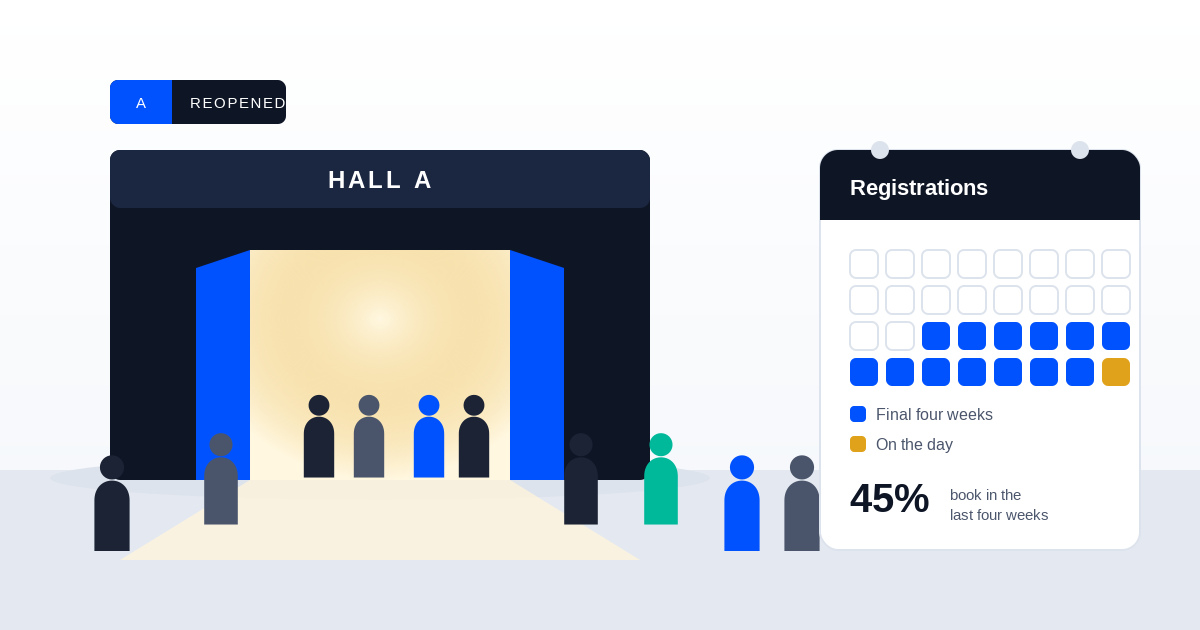
Almost every organiser has felt this. In a TSNN survey in early 2023, 98% of organisers said attendees were registering later than before the pandemic (a small sample of 60, but a near-unanimous one). The hard data backs them up.
Source: Maritz Registration Insights Report: 360,000+ registrations across 30 trade shows, via BizBash
And it hasn't eased: Freeman found that half of events were behind their usual registration pace in 2025. Here's the twist, though. In a separate survey of more than 3,400 attendees and exhibitors, Freeman found that 84% of attendees decide to go at least a month ahead. The decision happens early; the booking happens late. That changes the job from “panic at six weeks out” to “get people who have already decided to commit sooner”.
Hybrid faded, but not everywhere
Bizzabo's own platform data shows how far the pendulum swung back: 63% of events are in person, 33% virtual and just 4% hybrid. But that isn't the whole story. In IDC’s 2026 sponsor survey of 150 senior B2B tech marketers, 57% named hybrid as their top format for 2026. Hybrid as the default for every event faded; in some sectors, tech especially, it's very much alive.
Sponsors want proof, not presence
The same IDC survey shows what sponsors now judge events on: cost per opportunity (67%) and lead quality and conversion (60%) top the list, and 84% say price-to-value is what they look for in an event partner. Organisers are getting better at answering: Bizzabo found 40% of organisers struggled to prove event ROI in 2026, down from 70% in 2025. That still leaves a lot of sponsors waiting for proof.
The meeting became the product
Attendees are clear about why they turn up. In Bizzabo's 2025 State of Events report, 72% of attendees said in-person conferences offer the best networking, yet only 30% felt their last event gave them enough of it. That gap is where the best events now compete (more on that in our post on 1-2-1 meetings).
What hasn't changed
People still buy from people. Deals still move forward over dinner. Covid didn't change why B2B events matter; it raised the bar for what a good one looks like.
Sources
- UFI, Global Exhibition Industry Statistics (May 2025)
- IAEE / CEIR, 2025 CEIR Index update (May 2026)
- IAEE / CEIR, Q2 2025 Index Report (Sept 2025)
- TSNN organiser survey via BizBash (Feb 2023)
- Maritz Registration Insights Report via BizBash (May 2024)
- Trade Show Executive: Freeman 2025 research highlights
- A Media Operator: Freeman Trends Report on decision timing
- Bizzabo, event marketing statistics (2026)
- IDC, 2026 Sponsor Survey (Oct 2025)
- Bizzabo 2025 State of Events, networking findings (Apr 2025)
Every figure in this post was checked against the source linked above. Where trusted data doesn't exist, we say so.